
How Is AI Changing Medical Coding? Benefits, Challenges, and Real-World Applications
 Emily Thompson

Imagine a medical coder beginning their day with dozens of patient records waiting for review. Each record contains physician notes, diagnoses, procedures, medications, and details that must be translated into accurate medical codes.
One missing detail or incorrectly assigned code can create problems for reimbursement, reporting, or compliance.
Now imagine software that can read those records, identify relevant clinical information, suggest appropriate codes, and flag inconsistencies before claims are submitted.
This is no longer just a futuristic possibility. Artificial intelligence is already changing how medical coding work is performed.
From analyzing clinical documentation to identifying potential coding errors, AI in medical coding is becoming an important part of healthcare administration.
But how reliable is it? Can it genuinely improve coding accuracy? And could it eventually replace human coders?
The answers are more complicated and interesting than the technology’s promises might suggest.
What Is AI in Medical Coding?
Medical coding involves translating healthcare diagnoses, procedures, and services into standardized alphanumeric codes.
In the United States, common coding systems include ICD-10-CM for diagnoses, CPT for medical procedures and services, and HCPCS Level II for certain supplies and services.
These codes support insurance claims, reimbursement, healthcare reporting, and administrative processes.
Traditionally, trained medical coders review clinical documentation, interpret coding guidelines, and assign the appropriate codes.
AI medical coding introduces intelligent software that assists with parts of this process.
Using technologies such as natural language processing (NLP), machine learning, and large language models, these systems can analyze clinical text and identify information relevant to code assignment.
While AI can support code identification and documentation review, professional medical coding services remain essential for applying accurate codes, maintaining compliance, and handling complex clinical records.
As coding decisions must follow official guidelines, documentation requirements, and applicable payer rules.
How Does AI Medical Coding Software Actually Work?
AI medical coding software typically follows a process that combines clinical text analysis with coding knowledge and validation rules.
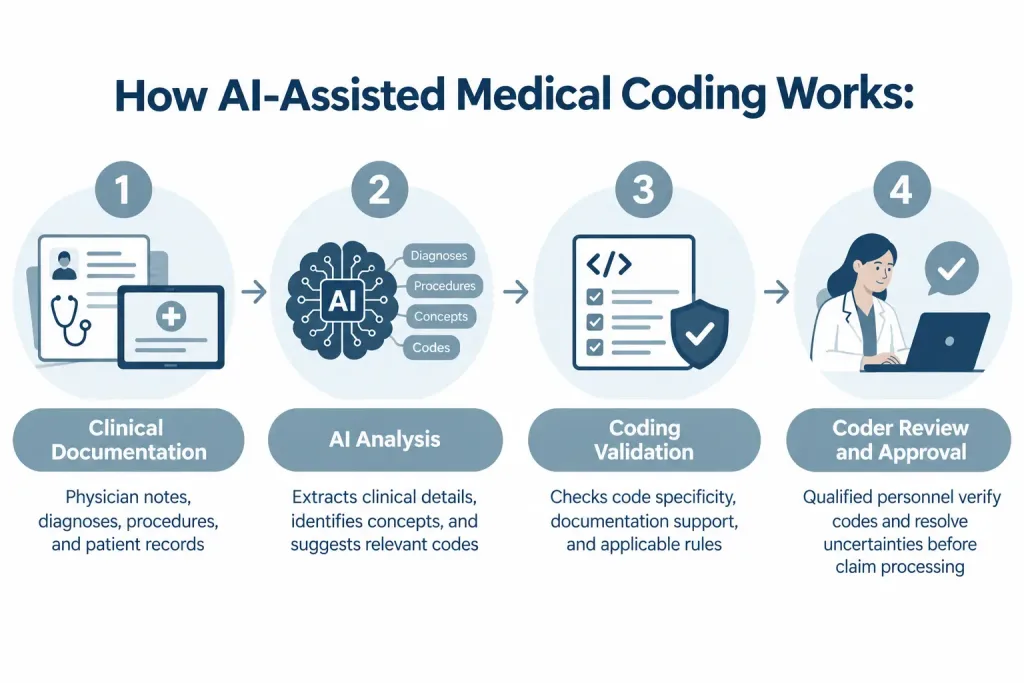
This represents a supervised workflow. Actual AI coding systems differ in their capabilities, controls, and levels of automation.
For example, a physician may document several conditions during one encounter. A medical coding AI system can suggest corresponding ICD-10-CM codes while highlighting missing specificity or conflicting information.
A human coder can then verify whether the documentation supports those suggestions.
What Are the Biggest Benefits of AI in Medical Coding?
Reducing Repetitive Manual Work
Medical coders spend considerable time reviewing lengthy records and searching for relevant documentation.
AI can help identify clinical terms, organize information, and prioritize records requiring attention.
This may reduce repetitive tasks and allow coders to focus on complicated cases.
Supporting Coding Accuracy
AI systems can identify possible omissions, inconsistencies, and coding patterns that warrant review.
For instance, a system might flag a diagnosis that appears in clinical documentation but is missing from the proposed coding summary.
However, an AI-generated suggestion must still be checked against reporting guidelines.
Improving Documentation Review
Incomplete or conflicting documentation creates challenges for medical coders.
AI tools may identify missing clinical details or suggest that clarification is needed before coding can be finalized.
This can support clinical documentation improvement programs, provided queries remain compliant and do not encourage unsupported diagnoses.
Helping Teams Manage Workloads
Healthcare organizations process large volumes of clinical records.
AI-assisted prioritization can help coding departments separate straightforward encounters from cases requiring more extensive review.
The American Hospital Association identifies administrative burden reduction and coding support as potential benefits of responsible AI adoption.
Beyond coding, healthcare organizations can improve administrative coordination through comprehensive revenue cycle management services that connect coding, claims processing, denial management, and payment follow-up.
What Does Research Reveal About AI Coding Accuracy?
One of the biggest questions surrounding AI and medical coding is whether intelligent systems can reliably assign correct codes.
A 2025 study published in npj Health Systems investigated large language models trained with specialized ICD-10 knowledge.
Researchers used 74,260 ICD-10 code-description pairs in their initial training approach.
When evaluated on real-world clinical notes, the enhanced system achieved:
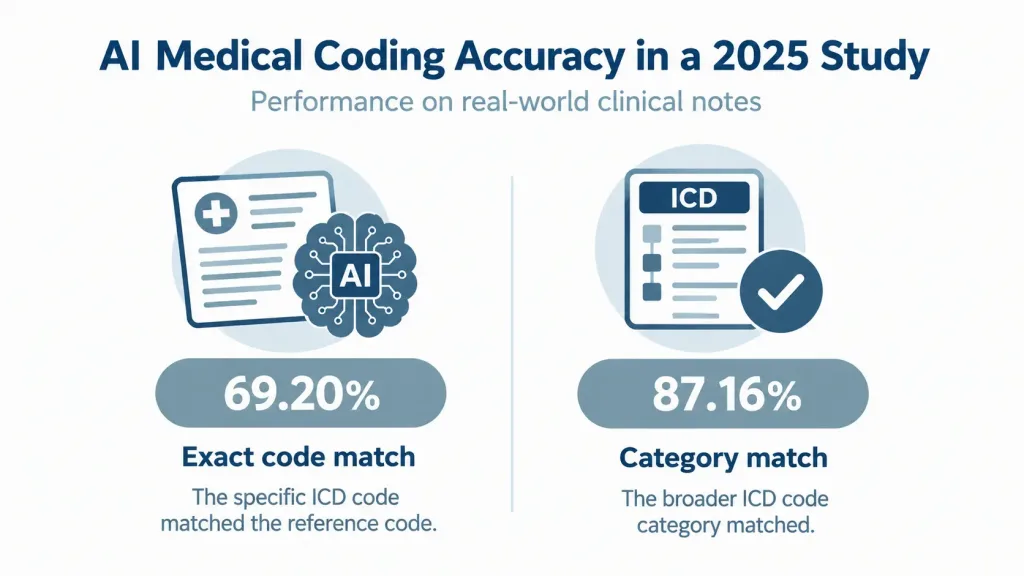
Source: Enhancing Medical Coding Efficiency Through Domain-Specific Fine-Tuned Large Language Models, 2025. Results describe the tested model and dataset, not the accuracy of all commercial AI systems.
The findings highlight both the potential and limitations of medical coding AI.
Even a system that frequently identifies the correct code category may still select an incorrect specific code.
In real billing environments, that distinction matters.
Real-World Applications of AI in Medical Coding
AI is being incorporated into several healthcare coding workflows.
| Application | How AI can help |
|---|---|
| Computer-assisted coding | Suggests codes from clinical documentation |
| Clinical documentation review | Highlights missing or conflicting information |
| Coding quality assurance | Flags potentially incorrect or unsupported codes |
| Claims preparation | Identifies possible coding problems before submission |
| Coding audits | Helps prioritize encounters for human review |
| Workload management | Organizes straightforward and complex coding cases |
Some organizations also explore autonomous coding for carefully defined, lower-complexity encounters.
However, these systems still require monitoring, audits, and appropriate accountability.
The American Health Information Management Association (AHIMA) emphasizes that AI-supported coding should operate with suitable safeguards and human oversight.
What Are the Challenges of AI Medical Coding?
Despite its advantages, AI medical coding software introduces several important challenges.
Incorrect interpretation: Clinical notes frequently contain abbreviations, uncertain diagnoses, and complicated medical terminology. AI may misinterpret these details or generate unsupported codes.
Regulatory compliance: Medical coding must follow current guidelines. The Centers for Medicare & Medicaid Services (CMS) updates ICD-10 code sets and coding guidance, requiring software and coding teams to remain current.
Patient privacy: AI systems processing medical records must meet applicable privacy and security requirements, including HIPAA where relevant.
Automation bias: Coders may become overly confident in AI-generated recommendations, particularly when systems report high confidence scores.
Implementation costs: Software integration, staff training, ongoing audits, and maintenance can create substantial expenses.
These challenges make careful evaluation essential before implementing medical coding AI across healthcare organizations.
Will AI Replace Human Medical Coders?
AI will likely change the responsibilities of medical coding professionals, but complete replacement is neither inevitable nor currently justified by the evidence.
Coding involves more than recognizing medical terminology. Professionals must interpret documentation, apply complex guidelines, resolve ambiguities, and exercise judgment.
The American Medical Association promotes augmented intelligence, emphasizing technology that supports human expertise rather than simply replacing it.
As AI and medical coding continue to evolve, coders may increasingly concentrate on quality assurance, complex encounters, compliance, and auditing.
The strongest approach is likely to combine efficient automation with qualified professional oversight.
Final Thoughts
AI in medical coding is transforming how healthcare organizations manage documentation, assign codes, and review coding quality.
Its potential benefits include reduced administrative workloads, improved consistency, and faster identification of coding issues.
However, medical coding AI is not infallible. Research demonstrates meaningful progress, but accurate documentation, updated coding rules, and human judgment remain essential.
The future of medical coding isn’t simply about making AI more powerful. It’s about using technology responsibly to make coding processes more accurate, efficient, and reliable.
Stay Updated
Get weekly RCM insights, trends and expert strategies delivered to your inbox.