
How Generative AI Could Change Medical Billing Over the Next Five Years
 Emily Thompson

Imagine a medical billing team starting its morning without hundreds of claims waiting for manual review, unanswered insurance inquiries, or lengthy denial letters requiring individual responses.
Instead, an AI-powered system has already organized the claims, identified missing information, drafted appeal letters, and highlighted cases that need immediate attention.
The billing professionals can spend less time searching through records and more time resolving complicated issues.
This is one possible future of healthcare administration, and generative AI could help make parts of it a reality over the next five years.
Unlike traditional automation, which follows predefined instructions, generative AI can interpret information, summarize documents, draft responses, and support complex administrative decisions.
But will it genuinely improve medical billing? How much can it automate? And what happens when AI makes a mistake?
Understanding these questions is becoming increasingly important as healthcare organizations explore AI medical billing solutions.
Why Medical Billing Needs Smarter Technology
Medical billing is far more complicated than submitting a claim and waiting for payment.
Healthcare providers must verify insurance coverage, review documentation, assign appropriate codes, submit claims, track reimbursements, and resolve denials.
Every step involves different requirements, and even small errors can delay payment.
According to the 2025 CAQH Index, released in February 2026, electronic administrative transactions helped the U.S. healthcare industry avoid approximately $258 billion in administrative costs in 2024.
Yet the report identified another $21 billion in potential annual savings through further automation of manual and partially manual transactions.
These figures refer to administrative automation broadly, not savings generated specifically by generative AI.
Still, they reveal how much opportunity remains for improving healthcare workflows.
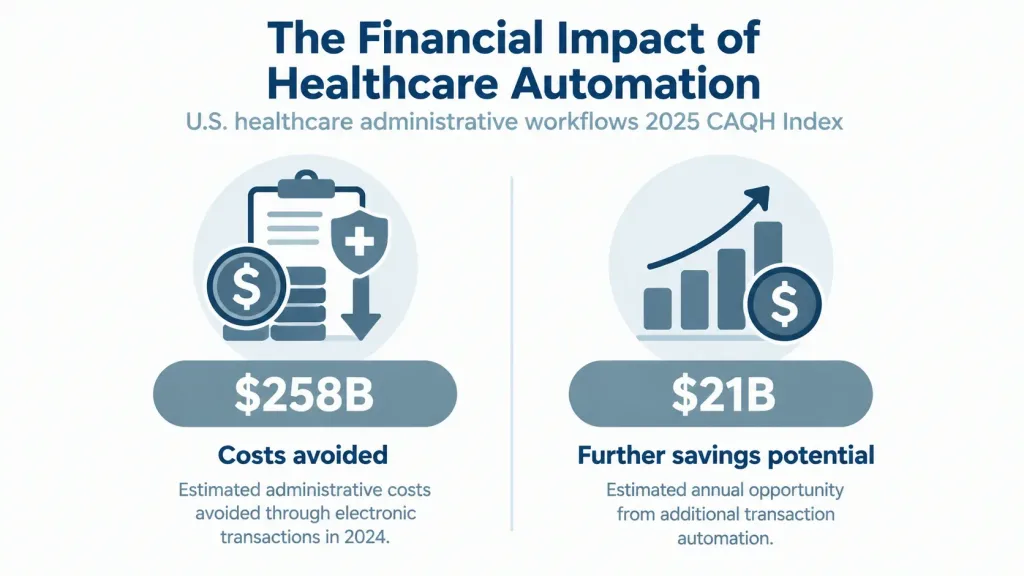
Source: CAQH, 2025 Index. These figures describe different measures, not proven generative AI savings.
What Makes Generative AI Different From Traditional Billing Automation?
Traditional medical billing automation performs specific tasks using established rules.
For example, software might check whether required claim fields are complete or automatically transmit an electronic claim.
Generative AI adds another capability: understanding and producing human-like language.
AI medical billing software equipped with generative AI could summarize lengthy payer policies, interpret denial explanations, prepare supporting documentation, or draft messages to insurance companies.
However, generative AI doesn’t inherently know whether a claim is compliant or payable.
Reliable systems must combine language models with updated billing rules, structured data, security controls, and professional review.
This distinction will shape how AI in medical billing develops.
Five Ways Generative AI Could Transform Medical Billing by 2031
Identifying Claim Problems Before Submission
One promising application is identifying potential claim issues before they reach the insurance company.
AI systems could compare clinical records, coding information, and payer requirements to flag missing documentation or inconsistent details.
For example, a claim might contain a procedure code but lack supporting documentation required by the payer.
Instead of discovering the issue after denial, the billing team could investigate it before submission.
These capabilities could complement existing professional medical billing services, where accurate claim preparation and follow-up remain essential.
The goal wouldn’t be to guarantee every claim gets paid, but to reduce avoidable mistakes and make reviews more efficient.
Making Denial Management More Efficient
Claim denials create additional work for healthcare practices.
Billing professionals must understand why a claim was rejected or denied, review supporting records, correct appropriate errors, and sometimes prepare an appeal.
Generative AI could help by summarizing denial letters, identifying relevant payer requirements, and drafting appeal documentation for human approval.
This is particularly useful when teams manage large volumes of correspondence.
However, an AI-generated appeal must never invent medical necessity, diagnoses, or supporting evidence.
The strongest systems will help professionals work faster while preserving the accuracy of every submitted statement.
Supporting AI in Medical Coding
Coding and billing are closely connected.
Incorrect or unsupported codes can create reimbursement problems, compliance risks, and unnecessary rework.
Over the next five years, generative AI could strengthen AI in medical coding by extracting relevant clinical details, suggesting appropriate codes, and highlighting documentation gaps.
For instance, a system might recognize that a physician’s note lacks the specificity needed for a particular diagnosis code.
However, identifying medical terms is not the same as applying official coding guidelines.
Qualified coders will remain important for reviewing complex cases, confirming documentation, and ensuring compliant submissions.
Automating Insurance Inquiries and Prior Authorization
Prior authorization remains a significant administrative challenge.
A 2026 American Medical Association survey found that physicians and their staff spend an average of 13 hours per week completing prior authorizations.
Generative AI could help prepare authorization requests, summarize clinical evidence, and organize insurer responses.
Meanwhile, CMS is requiring certain payers to implement electronic prior authorization interfaces, with major requirements beginning in 2027.
These developments could make insurance-related workflows more connected, although electronic authorization and generative AI are different technologies.
Making Patient Bills Easier to Understand
Medical bills can be confusing, particularly when insurance adjustments, deductibles, and patient responsibilities appear together.
Future AI medical billing software could translate complex billing statements into clearer explanations.
Patients might ask why a service costs a certain amount or what an insurance adjustment means and receive an understandable response.
The Healthcare Financial Management Association (HFMA) has already reported growing patient interest in using generative AI to review and question medical bills.
However, AI-generated explanations must be checked against actual account information and insurance benefits.
What Could Medical Billing Look Like by 2031?
| Billing process | Potential generative AI application |
|---|---|
| Claim preparation | Identifying missing information |
| Medical coding | Suggesting codes for professional review |
| Denial management | Summarizing denials and drafting appeals |
| Prior authorization | Preparing documentation |
| Patient billing | Explaining charges in simpler language |
| Payment follow-up | Prioritizing unresolved accounts |
These are realistic potential applications, not guaranteed industry-wide outcomes.
What Challenges Could Slow AI Adoption?
Despite its potential, AI in medical billing presents important risks.
Generative AI can produce convincing but incorrect information, sometimes called hallucinations.
In medical billing, this could result in unsupported coding suggestions, inaccurate appeal statements, or misleading patient communications.
Privacy is another major concern. Systems handling protected health information must comply with applicable security and privacy requirements, including HIPAA.
Implementation also requires investment in software integration, training, monitoring, and quality assurance.
A 2025 HFMA survey found that 88% of surveyed health systems were using AI internally, but only 18% reported mature AI governance and a fully developed strategy.
This highlights why responsible implementation matters as much as technological capability.
Will Generative AI Replace Medical Billing Professionals?
Generative AI may automate portions of repetitive administrative work, but complete replacement of billing professionals is unlikely to be a realistic near-term assumption.
Complex denials, payer disputes, coding compliance, unusual insurance arrangements, and patient concerns still require professional judgment.
Instead, medical billing automation could change how teams spend their time.
Professionals may increasingly focus on exception handling, auditing, compliance, and resolving difficult reimbursement cases while technology supports routine work.
Healthcare practices will also need experienced teams capable of connecting new technology with dependable revenue cycle management services.
Ultimately, successful AI adoption should be measured through accuracy, cost, turnaround time, compliance, and patient experience, not simply the number of tasks automated.
The Future Is AI-Assisted, Not Entirely Automated
Over the next five years, generative AI could make medical billing faster, more organized, and easier to manage.
From documentation review and coding assistance to denial management and patient communication, its applications are expanding.
Yet technology alone cannot guarantee accurate claims, fewer denials, or faster reimbursement.
The greatest opportunity lies in combining intelligent automation with experienced billing professionals, reliable data, and strong oversight.
For healthcare organizations, preparing for this future means adopting technology thoughtfully while keeping accuracy, compliance, and patient trust at the center of every decision.
Stay Updated
Get weekly RCM insights, trends and expert strategies delivered to your inbox.