
How AI Is Changing Patient Billing and Payment Experiences
 Emily Thompson

Medical billing has long been one of the most confusing parts of the healthcare experience. Between insurance adjustments, unexpected charges, complicated statements, and lengthy payment processes, patients often struggle to understand exactly what they’re paying for.
But artificial intelligence is beginning to change how healthcare organizations handle these challenges.
From explaining medical bills in simpler language to improving cost estimates and streamlining payment processes, AI in medical billing is creating new possibilities for both patients and healthcare providers.
While medical billing automation isn’t entirely new, recent advances in AI are making these systems more capable of understanding information, identifying errors, and supporting personalized communication.
So, how much of a difference can AI actually make to the patient billing experience, and what challenges still need to be addressed?
Why Patient Billing Needs to Change
Medical bills are rarely straightforward.
A patient may receive separate charges from a hospital, physician, laboratory, or specialist. Insurance deductibles, copayments, and coverage limitations can make the final amount difficult to understand.
The problem goes beyond inconvenience.
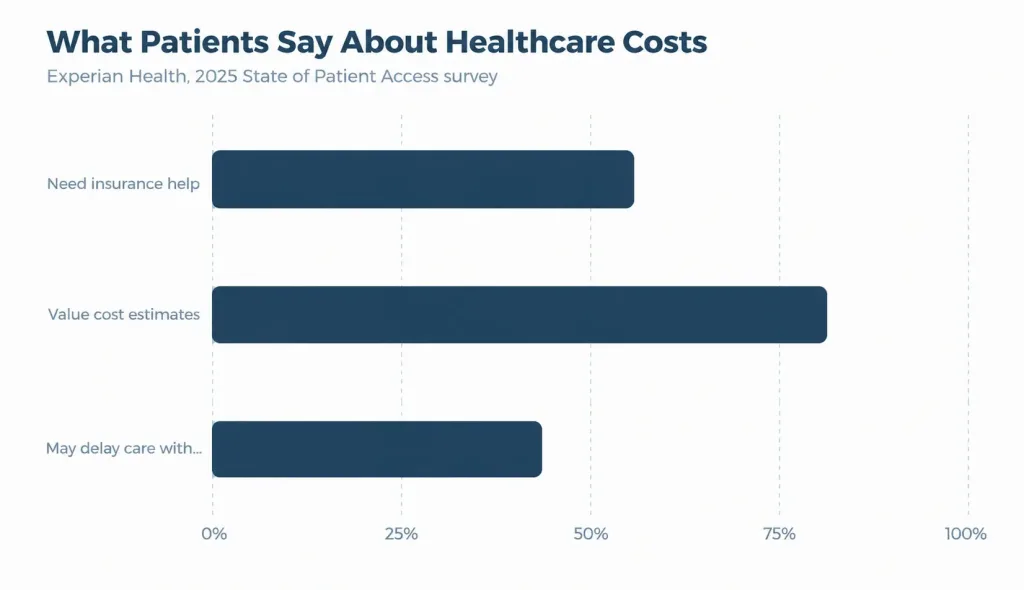
According to Experian Health’s 2025 State of Patient Access survey, which included more than 1,000 healthcare consumers:
- 56% said they needed help understanding what their insurance covered.
- 81% said accurate cost estimates helped them prepare for payment.
- 43% said they were likely to postpone or cancel care without a cost estimate.
These figures reveal how financial uncertainty can influence the overall healthcare experience.
For healthcare providers, this creates an important opportunity, make billing clearer and more accessible before frustration develops.
How Does AI Medical Billing Actually Work?
Traditional billing systems use established rules to process claims, calculate balances, and record payments.
Modern AI medical billing software can introduce additional capabilities, including predictive analytics, natural language processing, and automated communication.
For example, AI can analyze insurance information, identify inconsistent patient details, or explain complicated billing terminology in simpler language.
Some systems also use machine learning to identify patterns associated with claim denials or payment delays.
However, not every automated billing tool uses artificial intelligence. A payment reminder sent automatically according to a fixed schedule, for instance, is basic automation rather than necessarily AI.
Understanding that distinction helps healthcare organizations evaluate technology realistically.
6 Ways AI Is Improving Patient Billing Experiences
Providing Clearer Medical Bill Explanations
Medical billing statements often contain terminology patients rarely encounter outside healthcare.
Generative AI can help translate these terms into simpler explanations.
For example, patients could ask why their insurance paid only part of a procedure or what a deductible means.
An appropriately designed AI assistant could explain the terminology using verified account information.
The Healthcare Financial Management Association (HFMA) reported in 2026 that patients were increasingly exploring generative AI tools to understand and challenge medical bills.
However, AI explanations must remain consistent with actual insurance documents and payment records.
Making Healthcare Costs More Predictable
Unexpected medical expenses can create significant stress.
AI-supported systems may combine insurance eligibility information, contracted rates, and patient benefits to help estimate out-of-pocket costs before treatment.
This can help patients understand potential expenses and plan accordingly.
In the United States, the No Surprises Act also establishes important billing protections. Uninsured and self-pay patients generally have rights to good faith estimates for scheduled care.
AI may help organize information used in estimates, but it cannot guarantee final charges.
Offering More Convenient Payment Options
Patients increasingly expect healthcare payments to be as accessible as other digital transactions.
Medical billing automation can support online payment portals, electronic statements, reminders, and installment-plan administration.
AI may add personalized communication or help identify which available payment arrangements meet a patient’s expressed preferences.
These systems should present actual provider-approved options rather than independently making financial commitments.
Convenience matters, but affordability remains a separate challenge that technology alone cannot solve.
Reducing Errors That Affect Patients
Incorrect patient information, outdated insurance details, or coding inconsistencies can create billing problems.
AI-powered validation tools can help identify certain errors before claims are submitted.
Similarly, AI in medical coding may support documentation review and suggest codes for professional verification.
This can complement professional medical billing services that address claim preparation, insurance verification, payment posting, and patient billing inquiries.
However, coding decisions must still follow applicable guidelines, and automated recommendations require appropriate oversight.
Making Billing Support More Accessible
Patients may have questions outside normal office hours.
AI-powered chat assistants can potentially answer routine questions about payment methods, billing terminology, or where to find account information.
This may reduce waiting times for straightforward inquiries.
But certain situations should always be escalated to trained staff, particularly disputed charges, financial hardship, insurance disagreements, or complex payment concerns.
The goal should be faster access to help, not making it harder for patients to reach a real person.
Improving Communication Throughout the Payment Process
A confusing bill often becomes more frustrating when patients don’t know what happens next.
AI systems can help organize billing correspondence, identify unresolved inquiries, and support more consistent communication.
For example, an assistant might explain whether a claim is still being reviewed by an insurer or whether the provider has posted a payment.
When connected to reliable billing records, these features can make the process more transparent.
What Does AI-Powered Patient Billing Look Like in Practice?
| Patient concern | Potential AI-supported solution |
|---|---|
| Confusing medical charges | Plain-language billing explanations |
| Unexpected expenses | Personalized cost estimates |
| Insurance information errors | Automated eligibility checks |
| Difficulty reaching billing staff | AI-assisted support with human escalation |
| Complicated payment processes | Digital payment options and approved plans |
| Unclear claim status | Account updates based on verified billing records |
These applications demonstrate how technology can improve communication, although availability and accuracy vary between healthcare organizations.
What Are the Risks of Using AI in Patient Billing?
Despite its potential, AI medical billing software is not without limitations.
Incorrect information: Generative AI can produce explanations that sound convincing but are inaccurate. A billing assistant could misunderstand an insurance adjustment or incorrectly describe coverage.
Patient privacy: Billing systems handle sensitive information. Healthcare organizations must implement appropriate security controls and comply with HIPAA and other applicable requirements.
Unfair payment practices: Predictive models should not automatically pressure patients into payment arrangements or make inappropriate assumptions about their financial circumstances.
Limited human support: Some patients prefer speaking directly with billing professionals, especially when dealing with unexpected medical expenses.
Responsible implementation requires accuracy checks, accessible human support, and clear accountability.
Why Medical Billing Professionals Still Matter
AI can help simplify routine interactions, but patient financial experiences involve more than technology.
Insurance disputes, financial assistance requests, unusual billing situations, and complaints often require human judgment and empathy.
For healthcare providers, combining appropriate automation with experienced revenue cycle management services can support both operational efficiency and patient communication.
The focus should remain on helping patients understand their financial responsibilities while maintaining accurate, compliant billing processes.
Final Words
AI is creating new opportunities to make medical billing easier to understand, more transparent, and more convenient.
From intelligent cost estimates to clearer statements and digital payment support, these technologies may help address frustrations that patients have experienced for years.
However, successful AI in medical billing isn’t simply about automating more tasks.
It’s about providing accurate information, protecting patient data, offering meaningful assistance, and ensuring people can reach qualified professionals when needed.
The future of patient billing should be measured not only by how efficiently payments are processed, but also by how clearly and fairly patients are treated throughout the experience.
Stay Updated
Get weekly RCM insights, trends and expert strategies delivered to your inbox.