How Predictive Analytics Helps Healthcare Organizations Reduce Claim Denials
 Emily Thompson

Imagine a healthcare practice submitting hundreds of insurance claims every week. The billing team carefully checks patient information, medical codes, and insurance details before sending them to payers.
Still, weeks later, several claims return unpaid. Some have missing authorizations, others contain coding inconsistencies, and a few were denied because of payer-specific requirements.
Now imagine knowing which claims were likely to be denied before they were submitted.
That’s exactly what predictive analytics aims to make possible.
By analyzing historical claims, identifying patterns, and estimating denial risks, artificial intelligence can help healthcare organizations find potential problems earlier.
As AI in healthcare billing evolves, predictive analytics is becoming an important tool for improving claim accuracy, reducing administrative work, and supporting revenue cycle management.
But how does it actually work, and how much difference can it make?
Why Claim Denials Remain a Major Healthcare Challenge
A denied medical claim means an insurer has declined payment for a submitted service, either entirely or partially.
Sometimes, the problem is straightforward, such as incorrect patient information. Other times, it involves complicated medical necessity rules, documentation requirements, or insurance policies.
Regardless of the reason, denied claims create additional work.
Billing teams must investigate the problem, make necessary corrections, contact insurers, and potentially submit appeals.
The financial consequences can be substantial.
According to Experian Health’s 2025 State of Claims survey of 250 U.S. healthcare revenue cycle professionals:
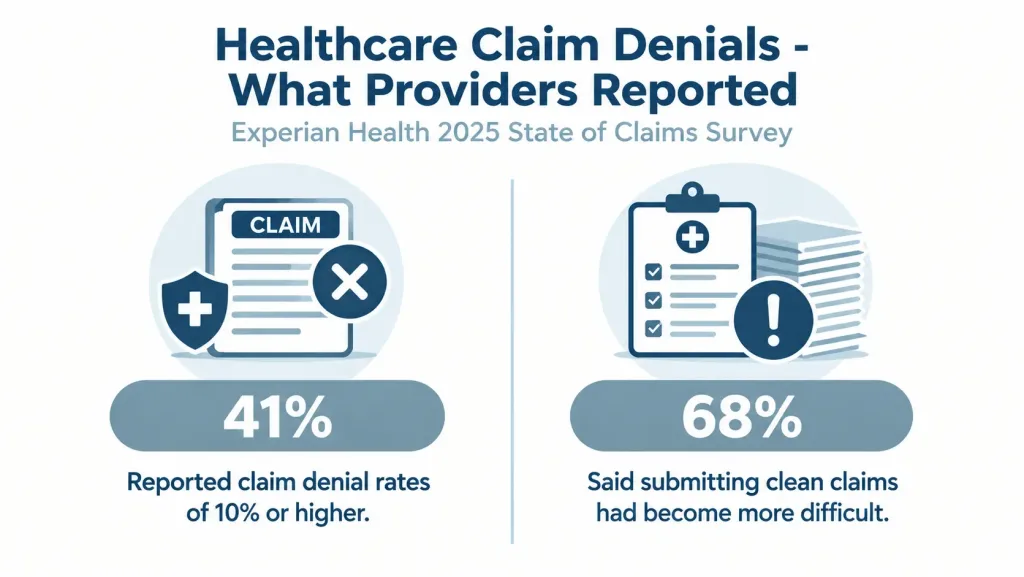
Source: Experian Health, September 2025. These figures describe survey respondents, not overall U.S. claim denial rates.
These findings explain why healthcare organizations are looking beyond traditional billing processes.
Instead of repeatedly correcting claims after denial, many are exploring ways to prevent avoidable errors earlier.
What Is Predictive Analytics in Healthcare Billing?
Predictive analytics uses historical data, statistical methods, and machine learning to estimate the likelihood of future events.
In medical billing, that future event might be an insurance claim being denied.
Imagine a system reviewing thousands of previously submitted claims. It may discover that claims involving certain procedures, missing authorizations, or particular payer requirements are denied more frequently.
When a new claim contains similar characteristics, the system can flag it for additional review.
This is an important application of AI in healthcare billing because it shifts attention from reacting to denials toward anticipating potential problems.
However, predictive analytics doesn’t guarantee that a claim will be approved or denied. It identifies risks based on available information and patterns.
How Does AI Predict Claim Denials?
Most predictive denial systems follow a process involving data analysis, risk assessment, and corrective action.
How AI-Powered Denial Prediction Works
Analyze Past Claims
Review historical approvals, denials, coding data, and payer patterns.
Identify Risk Patterns
Find factors associated with previous claim denials.
Flag High-Risk Claims
Estimate which new claims may need additional attention.
Review and Correct
Billing professionals investigate and resolve supported issues.
Submit the Claim
Send the reviewed claim and track the actual payer response.
Illustrative workflow. Actual predictive analytics systems differ in their data requirements, accuracy, and automation capabilities.
For example, a claim might receive a high denial-risk score because its authorization information is incomplete.
The system alerts the billing team, which checks whether authorization was required and obtained before submission.
This combination of technology and human review is central to effective medical billing automation.
Five Ways Predictive Analytics Can Help Reduce Claim Denials
Detecting Errors Before Claims Are Submitted
Missing or inaccurate information is one of the leading causes of claim denials.
Experian Health’s 2025 survey identified missing or inaccurate data, authorization issues, and incomplete patient registration among the most frequently reported denial drivers.
Predictive analytics can help identify patterns associated with these problems.
For instance, a system might flag inconsistent insurance details, missing identifiers, or unusual coding combinations.
Identifying these issues earlier gives billing teams an opportunity to review the claim before submission.
Identifying Payer-Specific Denial Patterns
Insurance companies have different coverage policies, documentation requirements, and reimbursement processes.
A claim accepted by one payer may require additional supporting information for another.
Predictive systems can analyze historical payer responses and identify recurring denial patterns.
This allows healthcare organizations to pay closer attention to claims involving specific insurers or procedures.
However, these models must be updated when payer requirements change.
Supporting Medical Coding Accuracy
Medical coding plays a major role in claim acceptance.
Incorrect diagnosis codes, unsupported procedures, or inappropriate modifiers can lead to denials and compliance concerns.
AI medical coding solutions can assist by analyzing clinical documentation and identifying possible inconsistencies.
Similarly, AI medical coding services may support coding review and quality assurance when combined with trained professionals.
Nevertheless, automated coding suggestions require verification against current coding guidelines and medical documentation.
Predictive analytics should never encourage coding changes solely to increase payment likelihood.
Prioritizing High-Risk Claims
Not every claim requires the same level of attention.
Some involve routine services and straightforward billing requirements. Others contain complicated procedures, documentation requirements, or payer restrictions.
Predictive analytics can help billing teams prioritize claims according to estimated risk.
This approach may improve workload management by directing experienced staff toward cases most likely to require intervention.
Improving Denial Management Strategies
Predictive analytics can also help after denials occur.
By examining denial reasons, payer responses, and previous appeals, organizations can identify recurring problems and improve future workflows.
The Healthcare Financial Management Association (HFMA) identifies predictive analytics and AI-assisted denial management as emerging approaches to reducing revenue leakage.
Healthcare organizations can complement these technologies with professional medical billing services that support claim preparation, coding accuracy, and consistent follow-up.
Does AI Actually Reduce Claim Denials?
Early industry findings are encouraging, but results vary.
In Experian Health’s 2025 survey, only 14% of respondents reported using AI for denial reduction. Among those users, 69% said AI had reduced denials and/or improved resubmission success.
These are self-reported outcomes, not independently verified reductions across all healthcare organizations.
Successful implementation depends on reliable data, accurate models, payer-rule updates, and experienced staff.
What Should Healthcare Organizations Consider Before Adopting AI?
Not every AI product is suitable for medical billing.
Some tools marketed as billing software for AI companies or a billing solution for AI companies are designed to manage software subscriptions and usage-based payments. These are different from healthcare claims processing systems.
Healthcare providers should evaluate software specifically designed for medical billing and revenue cycle management.
Key considerations include data security, HIPAA compliance, EHR integration, predictive accuracy, and human oversight.
Organizations should also monitor false alerts and missed denial risks.
A system that flags too many legitimate claims may create unnecessary work, while one that overlooks problems may provide little operational value.
Why Human Expertise Still Matters
Predictive analytics can identify patterns, but it cannot independently resolve every billing issue.
Clinical documentation, medical necessity disputes, unusual payer policies, and appeals often require experienced professionals.
Combining predictive technology with comprehensive revenue cycle management services can help organizations address both technical and operational billing challenges.
Rather than replacing billing teams, AI should support better decisions and more consistent workflows.
Final Thoughts
Claim denials remain a costly and time-consuming challenge for healthcare organizations.
Predictive analytics offers an opportunity to recognize potential problems before they become unpaid claims.
Through risk identification, coding support, payer-pattern analysis, and smarter workload management, AI in healthcare billing can help practices take a more proactive approach.
However, predicting a denial isn’t the same as preventing one.
Lasting improvements require accurate information, appropriate corrective action, updated billing rules, and knowledgeable professionals.
The real value of predictive analytics lies in helping healthcare teams make better decisions earlier, before avoidable billing problems affect reimbursement.
Stay Updated
Get weekly RCM insights, trends and expert strategies delivered to your inbox.